Concrete Driveway Replacement in Joliet, IL
Call (815) 605-5859 or use the homepage contact form.
Repeated patching does not correct a moving or deteriorated driveway base. When cracks reopen after winter and spalling spreads beyond the original repair, the slab and base need to be assessed together.
At a certain point, replacement is the more practical option because repair costs keep compounding while the slab continues to deteriorate. Tony compares repair and replacement at the estimate without pushing the higher-cost option.
What Replacement Fixes That Repair
Can't
Crack filling and section patching address the surface. They don't address what caused the damage in the first place. When a Joliet driveway has widespread cracking or heaved sections, the problem is usually in the base - frost penetration, poor sub-base compaction, or a grade that directs water under the slab instead of away from it.
Patching over a bad base produces a slab that looks better for one season before the same base movement cracks the patch. Replacement means starting with the base - fixing what the original pour didn't get right and giving the new slab the foundation to survive Will County winters.
Joliet Neighborhoods and Replacement
Patterns
Older Joliet neighborhoods - the areas around Cathedral Area, the historic districts near Bluff Street, and established streets near Pilcher Park - have original driveways that are 30–50 years old. These slabs have been through hundreds of freeze-thaw cycles. Some show repeated patching or movement. An estimate should start with the base, drainage, and panel condition rather than assuming age alone requires replacement.
Subdivision construction - Wesmere, Lakewood Falls, Caton Ridge, and the developments built in the 1990s through 2010s - poured builder-grade concrete that is now established rather than new. These driveways should be assessed from their current cracking, settlement, surface condition, drainage, and base support instead of a fixed age threshold.
Newer construction - properties built in the last 10–15 years generally have good original concrete. Tony still gets calls from newer areas for patios and walkway replacements where the original work was undersized or the base prep was inadequate.
What the Replacement Process Involves
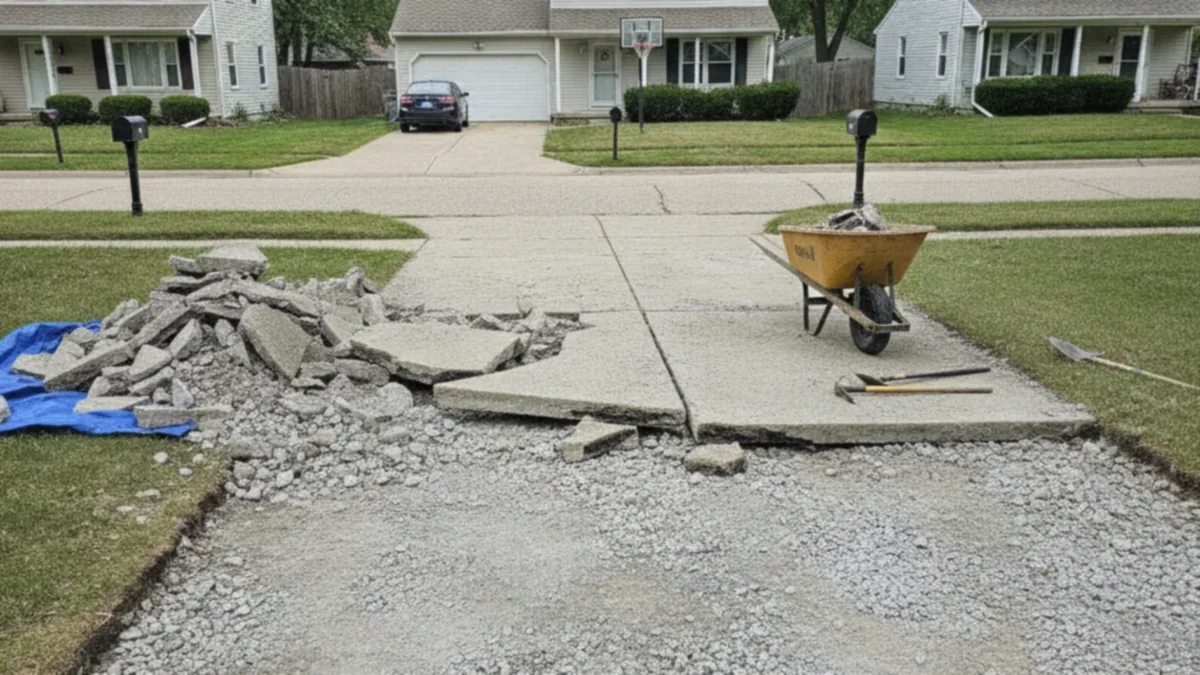
Removal and haul. The existing driveway is saw-cut, broken up, and hauled off the property. Included in the replacement quote.
Base inspection and repair. Once the old concrete is out, Tony looks at what's underneath. If the sub-base is solid and well-graded, it may need minimal work. If it's been compromised by frost or drainage issues, it gets corrected before any forming starts. Tony tells you at this stage if what he finds changes the scope.
Forming and grade. Forms set the driveway dimensions and thickness. Slope is planned so the finished surface drains away from the garage and foundation.
Control joint planning. The single most overlooked detail in residential concrete. Control joints give the slab relief points for expansion and contraction - without them, or with joints in the wrong places, cracking is random and unpredictable. Tony plans joint placement before the pour.
Air-entrained pour. Illinois winter specification concrete. Every time.
Finish and cure. Broom texture for traction, clean edge treatment, and adequate cure time before vehicle traffic.
Pricing for Driveway Replacement
- Standard two-car driveway: $3,500–$8,000
- Longer driveways or with approach sections: $6,000–$12,000
- Demolition and haul: included
- Base repair (if needed beyond standard prep): assessed on-site
Free on-site estimates. Tony gives a real number after walking the driveway
- not a range designed to get in the
door. Call (815) 605-5859.
Replacement FAQs
How long will a new driveway last in Joliet?
Longevity depends on base support, drainage, thickness, concrete mix, joints, curing, use, and winter maintenance. A properly designed driveway is intended as a long-term replacement, not another surface patch.
Can I get just the worst section replaced instead of the whole driveway?
Sometimes. Section replacement can make sense when the remaining panels and base are stable. Widespread cracking, settlement, or scaling may make full replacement the better use of the budget.
How long does a driveway replacement job take?
Many residential replacements use one phase for demolition and base work and another for forming, pouring, and finishing. Size, access, weather, inspections, and base correction determine the actual schedule.
What happens to the old driveway concrete?
The old slab is broken into manageable pieces, loaded out, and taken for appropriate disposal or recycling. The estimate should say whether demolition and haul-out are included.
How does Tony check the base after demolition?
With the slab removed, Tony can inspect support, soft areas, depth, drainage, and grade. Necessary correction is discussed before forms and new concrete hide the base again.